
On January 9, 2026, the US Department of Homeland Security (DHS) published an image on Instagram and Twitter of a solitary cowboy riding a horse through a rocky desert. It is a classic scene from the American west that could have come straight out of a John Ford movie – at least most of the photo could have. But far above our lone hero, for reasons that are beyond the comprehension of mere humans, is a stealth bomber. And between the two is a caption that reads “WE’LL HAVE OUR HOME AGAIN” along with the web address for the Immigration and Customs Enforcement (ICE) recruitment page.
Published just two days after an ICE officer murdered Renee Good in her car in Minneapolis, it should be no surprise that this image was subject to a lot of pushback. That was partly due to the blunt racism implicit in the idea that the state security apparatus has to take back “our home” from immigrants and partly due to the erasure of indigenous people, both past and present.
But another reason is that the phrase “We’ll Have Our Home Again” is also the title and refrain of a song that has been popular among North American neo-nazis for several years now.
The implication is not subtle, and I don’t want it to be missed among the details presented below, so I’m just going to say this clearly right here at the start: in citing this song by name in a recruitment ad, DHS is speaking directly to actual neo-nazis and telling them “We want to hire you.”
Trump and his supporters have had an all-too-complicated relationship with self-identified nazis over the years. It has been evident since Trump first announced his candidacy in 2015 that he was always going to run on racial resentment, blustering machismo, and raw elitism, and the policies he enacted during his first administration were consistent with that agenda. Once in office, however, much of the alt-right that cheered his rise quickly abandoned him because, in their view, he didn’t go far enough. In particular, they pointed to the difficulty Trump had building even part of the wall that he promised along the US-Mexico border, and they cited immigration statistics showing a continued loss of white numerical dominance. But just as damning was Trump’s support for Israel and the presence of Jews in leadership positions in his administration. The prominent role played by Trump’s son-in-law Jared Kushner was a constant reference point, and the fact that Trump would “allow” his Aryan daughter to convert and to produce children with the eternal racial enemy was just blasphemous. (How they didn’t know about this before the election is beyond me.)
During his second administration, Trump has largely alienated neo-nazis due to his continued support for the Israeli state and his lip service to the idea of combating antisemitism, however he has also taken steps that seem explicitly designed to make the US an all-white nation in ways that go far beyond even the policies of his first administration (which were already extreme). This is most visible in his wildly aggressive crackdown on mostly non-white immigrants and their descendants (whether or not they are citizens) and his offer of refugee status to white South Africans while also moving to cut off asylum claims from most of the rest of the world. These are actual policies that make even his first-term comments about “shithole countries” and the supposed need for more immigration from Scandinavia pale in comparison.
Nonetheless, while all of these previous moves have won Trump some (often grudging) approval from many white nationalists, he and his cabinet members seem to almost reflexively want to maintain the thinnest possible veneer of plausible deniability – just enough so that the more passive racists can continue to support him because, hey, he doesn’t hate anyone, he just wants to fight crime or something.
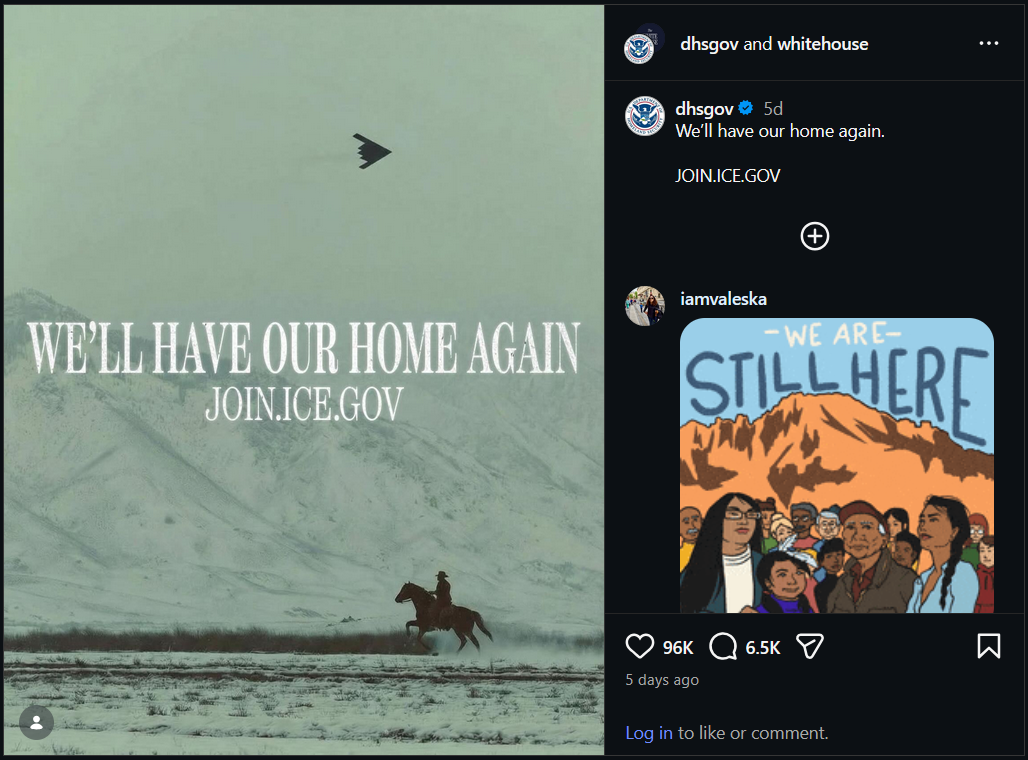
Citing “We’ll Have Our Home Again” is different. This is a song that is all but unknown outside of neo-nazi circles, but it is very well known within them. It is about the most specifically targeted dog whistle I can imagine. This is a call not to the generic racists who would rather not have to ever hear languages other than English or smell foods that aren’t on the menu at Cracker Barrel but rather to people who already have an explicit idea in their minds of just what they think an all-white country would look like and a fairly clear idea of how to get there. It is a call to the kind of people who really do read The Turner Diaries as inspiration – even a kind of blueprint – for forging a white ethnostate or who regard The Camp of the Saints as an allegory for the consequences of failing to do so. They have been trying to figure out how to violently DIY their way into just such a country for decades, and now DHS has signaled that it wants to elevate them to gun-toting, badge-wielding agents of the state.
The difference between, say, banning immigration from a list of Muslim-majority countries and directly appealing to neo-nazi recruits (while also continually adding to the list of banned countries) may only be one of degree, but at least in terms of the Trump administration’s relationship with its base, it is the difference between keeping casual racists happy versus calling on people who are openly pro-genocide. Fascists often seek to prevail by taking one inch at a time and disarming their adversaries by painting them as alarmists or worse, and this ad represents another inch taken. It is entirely possible that it was solely the product of one or two covert groypers working in the DHS social media office, but that doesn’t actually change anything. The signal has been given, and there is no real chance that DHS is going to start weeding out nazi recruits any time soon.
The Song Itself
In my personal observation, “We’ll Have Our Home Again” seemed to come from out of nowhere around 2019 or 2020, and once it emerged, neo-nazis couldn’t get enough of it. The recording that is widely used online is ascribed to “Pine Tree Riots” (if this outfit has ever recorded anything else, I’ve never come across it – and I’ve looked). It features a male singer accompanied only by what sounds like feet marching at a brisk pace during the verses and then a chorus of male voices during the refrain. (In my opinion, the pace is too fast and the singer often sounds like he’s gasping for breath trying to keep up, but then I’m not a nazi, and I don’t have nazi tastes. Whatever my shortcomings may be, at least I’ll always have that going for me.)
The lyrics themselves invoke a few different tropes that are popular among fascists of various stripes, so here’s a close reading.
The refrain:
Oh by God we’ll have our home again, by God we’ll have our home
By blood or sweat, we’ll get there yet, by God we’ll have our home
Fascism always relies on visions of an idealized past that has been lost and needs to be recovered. Twentieth century fascist intellectuals like Julius Evola and Savitri Devi usurped the Hindu idea of the Kali Yuga as a kind of cleansing apocalypse. For them, it is the fourth and final stage in an eternally repeating cycle of history during which the whole world is corrupted and everything collapses so that the purified elite can emerge from the fire on the other side and restart the cycle in a newly perfected world. That vision has been carried forward by the likes of Turner Diaries author William Pierce, whose 1978 novel ends in nuclear destruction for everyone but white fascists, who then find themselves living in an all-white Eden. Memes telling people to “surf the Kali Yuga” were very popular during the heyday of the alt-right some ten years ago now. So the idea that “our home” has been lost, but “we” will get it back “by blood or sweat” is deeply rooted in fascist ideology.
Additionally, fascists tend to continually project a sense victimhood in order to preemptively justify their own aggression, something I’ve been calling “hitting back first.” So the idea that “our home” has been taken away allows them to tell themselves (and anyone else who will listen) that they are the scrappy underdogs, even while they embody every conceivable form of unearned privilege that the world has to offer.
Moving on to the first verse:
When there’s nothing left, but the fire in my chest and the air that fills my lungs
I’ll hold my tears, and trade my years for a glimpse at Kingdom Come
On the other side of misery, there’s a world we long to see
The strife we share will take us there, to relief and sovereignty
The first line really doubles down on the scrappy underdog idea. To identify with this song means to position oneself as dispossessed of everything but one’s own raw will. “Kingdom Come” in this context is the purified, post-collapse promised land “on the other side of misery.” Meanwhile, “the strife we share” conjures the kind of soldierly comradeship that neo-nazis may or may not have actually known in real life: fascist (and similar) movements often arise after wars, and particularly wars that have been lost. We see this in the rise of the Ku Klux Klan after the US Civil War, the Freikorps militias that emerged in Germany after World War I, the Vietnam-era white power movement in the US, and other examples. At the same time, many white nationalists in the US today are bourgeois nerds destined to take over dad’s landscaping business when he retires, so this idea is aspirational for many of them.
Second verse:
In our own towns, we’re foreigners now, our names are spat and cursed
The headlines smack of another attack, not the last and not the worst
Oh my fathers they look down on me, I wonder what they feel
To see their noble sons driven down, beneath a coward’s heel
The first line could have been quoted directly from Renaud Camus, the French nationalist who coined the term “the Great Replacement.” In his book Le Grand Remplacement, Camus writes about visiting French cities and being appalled at the absence of people he regards as French, which is to say native French speakers with pale skin and a pedigree. He also conjures a strawman in the form of a Muslim woman “brimming with condemnation and animosity – not to say hatred – for our history and our civilization” who is given air time on French TV to talk over a genteel Frenchman and claim to be “just as French as you,” if not “more French.” In a similar vein, white nationalist elder statesman Jared Taylor recently published a recorded discussion with a colleague titled “[Vivek] Ramaswamy Says He’s More American Than You Are.” This constant defensiveness about who is the most French, the most American, etc., is like a really bad running joke in these circles, but the implication is that “real” French or American people are “foreigners now” in “their own” countries, again making them dispossessed underdogs who need to fight to reclaim their birthright.
The 1973 novel The Camp of the Saints – a frequent reference point for everyone from Steve Bannon to European “identitarian” movement leaders to the writers at really any white nationalist journal – reiterates this idea. It envisions an invasion of France and then the entire Western world by brown-skinned hordes who have only contempt for white people. In the world of that novel, having their names “spat and cursed” would be the least of white people’s problems.
White men as the subject of constant and ever-worsening attacks is fully in keeping with the idea of white victimhood and the manufactured anxiety over white “replacement,” while the disappointment of a dead father (or “fathers”) at the lowly state of his (their) “noble sons” provides a kind of spiritual motivation for white men to rise up and subjugate their inferiors. Moreover, nobility is traditionally a thing that is inherited. In this context, white men are noble simply because they are white men.
Third and final verse:
The road is dark, the way is lost, my eyes they strain to see
I struggle forth to find a friend to light the way for me
Oh brothers can you hear my voice? Or am I all alone?
If there’s no fire to guide my way, then I will start my own
In his position as a wronged underdog straining to reassert his innate greatness, the singer (and, by extension, the listener who identifies with the singer) places himself on an arduous journey with an uncertain destination – not something most of us would choose, but definitely a romantic idea to look at from the outside, if we can expect a glorious final outcome.

The isolation conjured in the second line is in keeping with the endless and misguided fixation that the US media seems to have with a putative crisis of “male loneliness,” which tends to ignore both loneliness among people who aren’t men as well as the ways that aggressive, often reactionary ideas of proper masculinity tend to encourage men to produce their own isolation in ways that feminism never could.
The last line is a bit ominous in light of the emergence of “leaderless resistance” as a doctrine among neo-nazis since the 1980s or 1990s (depending on how you look at it). Reading that line as a metaphor, the implication is that, if there is no guidance for taking action as a group, then the singer is empowered to take action on his own. Over the past decade, we have seen far too many examples of what that looks like.
Use of the Song by Neo-Nazis Online
There are evidently other remixes of “We’ll Have Our Home Again” circulating online, but it is the Pine Tree Riots recording that turns up over and over again. After this recording, Pine Tree Riots seems to have slunk back into obscurity, but it is worth noting that their name is derived from a pre-Revolutionary conflict that gave rise to the Pine Tree Flag emblazoned with the words “An Appeal to Heaven.” This flag has been taken up by Christian nationalists for over a decade now and came to national prominence when it was carried by numerous insurrectionists who attacked the US Capitol on January 6, 2021.
A search on streaming sites that are popular on the neo-nazi/white nationalist spectrum shows dozens of posts of this recording as well as far too many more recent recordings of it. Many of the accounts that have posted it have names that explicitly reference Nazi history – names like AryanNationalSocialist or Dawn of the Black Sun – and they frequently cite Männerbund as its source. With a German name that means “men’s league,” Männerbund is a shadowy, overwhelmingly English-speaking group (they seem to have no idea how their own chosen name is pronounced) that emphasizes the gendered aspects of white supremacy (hint: you can’t pursue racial purity without, at some point, trying to enforce racially pure reproduction and lots of it, women’s interests be damned). The appeal of German terminology, robbed of any context other than the Nazi fetishism of the people who use it, should be obvious.
The more homespun versions of “We’ll Have Our Home Again” are not so much cringy as just listless and boring. One version recorded in someone’s living room comes from an account on multiple platforms called The Belting Balaclava, which manages to conveniently unite Nazi fetishism with IRA fetishism in one tidy package (I really need to finish an article I started a while back titled “Ireland in the Fascist Gaze” – it’s a thing!). Other posts consist of videos specifically tailored to appeal to Canadian nationalism. But the video that seems to be most widely shared uses the Pine Tree Riots version against a montage that alternates between clips of things neo-nazis don’t like (riots, removal of Confederate statues, any example of Black people being unruly) with things neo-nazis do like (white people jumping off of boats, white children playing in fields, Bavarian folk dancing).
Neo-nazi Telegram channels are likewise filled with posts and re-posts of the song. In August 2023, US politician and current United States Agency for Global Media head Kari Lake commented on the song “Rich Men North of Richmond” on Twitter by thanking its author “for writing the anthem of this moment in American history.” A prominent neo-nazi Telegram account with close ties to Patriot Front and the Active Club network responded by posting the montage video and writing
By the way, Rich Men North of Richmond is not even close to our anthem. I can think of a dozen more suitable candidates. By God We’ll Have Our Home Again being the first that comes to mind.
The song has also been sung at in-person far-right gatherings. Most reports of its use in face-to-face situations have cited secret get-togethers by members of groups like Patriot Front and other overtly neo-nazi organizations. The most public use of it that I have come across was when a group of masked Proud Boys sang it at a Stop the Steal rally after the 2020 presidential election. It is worth pointing out, however, that while the Proud Boys have been noted for accepting non-white men in leadership positions, it was not long after the group was founded that neo-nazis began to join as part of an entryist strategy of either poaching white members or shifting the whole group toward are more nazi orientation and marginalizing or removing its non-white members. So while there is no way to know for certain whether the Proud Boys at that Stop the Steal rally were self-identified neo-nazis or just adhered to a slightly less racist kind of fascism, there is reason to suspect that at least some of them may have been the former, not the latter.
What Does This Mean for DHS Recruiting?
Thus far, there doesn’t appear to be much online chatter among neo-nazis about the new opportunity DHS has presented them with, but that doesn’t really mean much. What seems likely is that, as with previous gestures the Trump administration has made toward ethnonationalism, it will be well received by the white nationalists who are not so fixated on “the Jewish Question” and rejected by those who regard associating with Jews as a red line. For instance, Jared Taylor, who is happy to invite far-right Jews to speak at his annual conference (although he is just as eager to invite rabid antisemites), recently summarized Trump’s “achievements” this past year as follows:
Yes, it is easy to criticize his foreign policy, erratic nature, and self-absorption, but on race and immigration, he has done pretty much everything we would expect from a racially conscious white man. He isn’t one – not yet – but he seems to have very good men at his elbow. We will keep cheering when he gets it right and snarling when he doesn’t.
By contrast, the ones who are really committed to antisemitism (which, when we’re talking about neo-nazis, is all of them) are not as accommodating. Whatever they may like about what Trump has done in his second term always seems to be subordinated to their antisemitic fixation – at least for now.
However, what is particularly concerning here is the fact that DHS was willing to make such a targeted appeal to neo-nazis in the first place. Whether or not many – or even any – of them take up the offer, this is about as concrete as any evidence I’ve seen in the past year that the state security apparatus does not care in the least about excluding adherents to extreme racist and misogynist ideologies. Is that a surprise? Hardly. But the desire to maintain a shred of plausible deniability can be read as an indication of fear of at least some repercussions for terrible behavior. In my view, the use of “We’ll Have Our Home” in a DHS recruitment ad is the latest and, thus far, clearest indication that this administration feels a sense of impunity and has stopped caring at all.
 Total Propaganda