The Roots of “Replacement,” Part 2: Replacement as a Colonial Value

[Note: This essay quotes some extreme racist language, including genocidal rhetoric.]

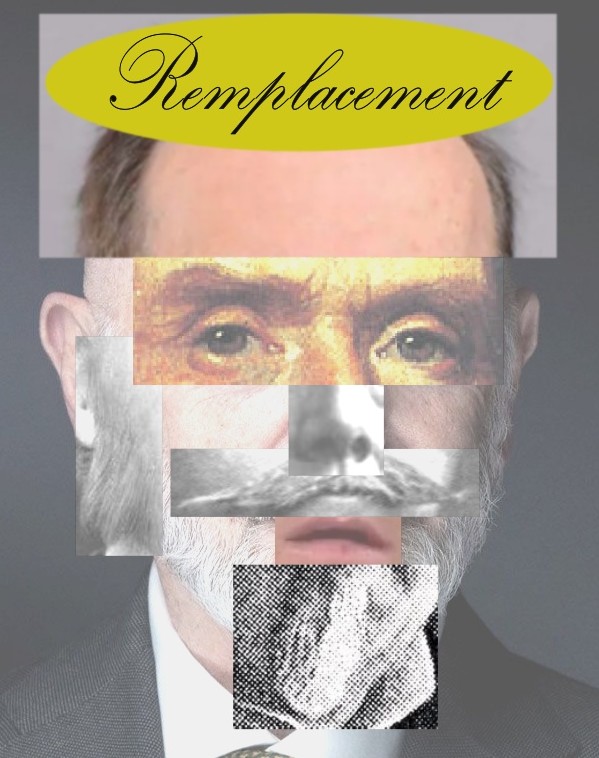
French nationalist Renaud Camus with the forehead of Alain de Benoist, the eyes of Thomas Jefferson, the sideburn of Francis Galton, the nose of Houston Stewart Chamberlain, the mustache of Madison Grant, the gaping mouth of Tucker Carlson, and the goatee of Arthur de Gobineau

Over the past decade we’ve heard seemingly endless variations on the “Great Replacement” trope from TV personalities, right-wing influencers, politicians, and howling neo-fascists on our streets. It has often been condemned as a conspiracy theory and a not-so-thinly veiled statement of anti-immigrant sentiment, but beyond that, most criticism takes the coinage of the term itself as its starting point, limiting its history to the past decade and a half. What is often left out is that the language of “replacement” has been able to spread so widely in part because replacement rhetoric has been embedded in Western thought for much longer than that.

For our purposes, we can roughly define replacement rhetoric as speech that is intended to provoke opposition to changes that allegedly threaten to alter existing demographic proportions and undermine the numerical advantage of a dominant group. In practical terms, this means opposition to immigration (and to immigrants themselves), regardless of whether or not any evidence exists showing actual harm done to the established population. Rhetoric of this kind can be traced back to at least the mid-nineteenth century and arguably well before that: if it is not necessarily a direct descendant of previously existing rhetoric in favor of “replacing” indigenous populations, then it is at least a close relative.

A previous post on this site raised the question of how the term “the Great Replacement” came to be used so widely within the English-speaking far right despite the fact that it is derived from French texts that have never been widely circulated (if at all) in English. It also addressed the way that French nationalist Renaud Camus, who coined the term, evocatively explained its meaning using what is known as constitutive rhetoric.

The next few posts will look at the long history of elite replacement rhetoric in Western Europe and the United States throughout the nineteenth and early twentieth centuries and how that rhetoric still echoes in the present day. In the meantime, however, the present essay will start by looking at the early part of that period – when Western political and intellectual leaders were so confident in their global power that they openly plotted and in some cases even executed the “replacement” of populations they regarded as their racial subordinates. If it is true that white people often harbor a fear that what whiteness has done to others may one day be done to them, then this background should help us understand a little bit better how and why fear of being “replaced” took hold.

Continue reading

Decoding Authoritarian State Language in the MAGA Era

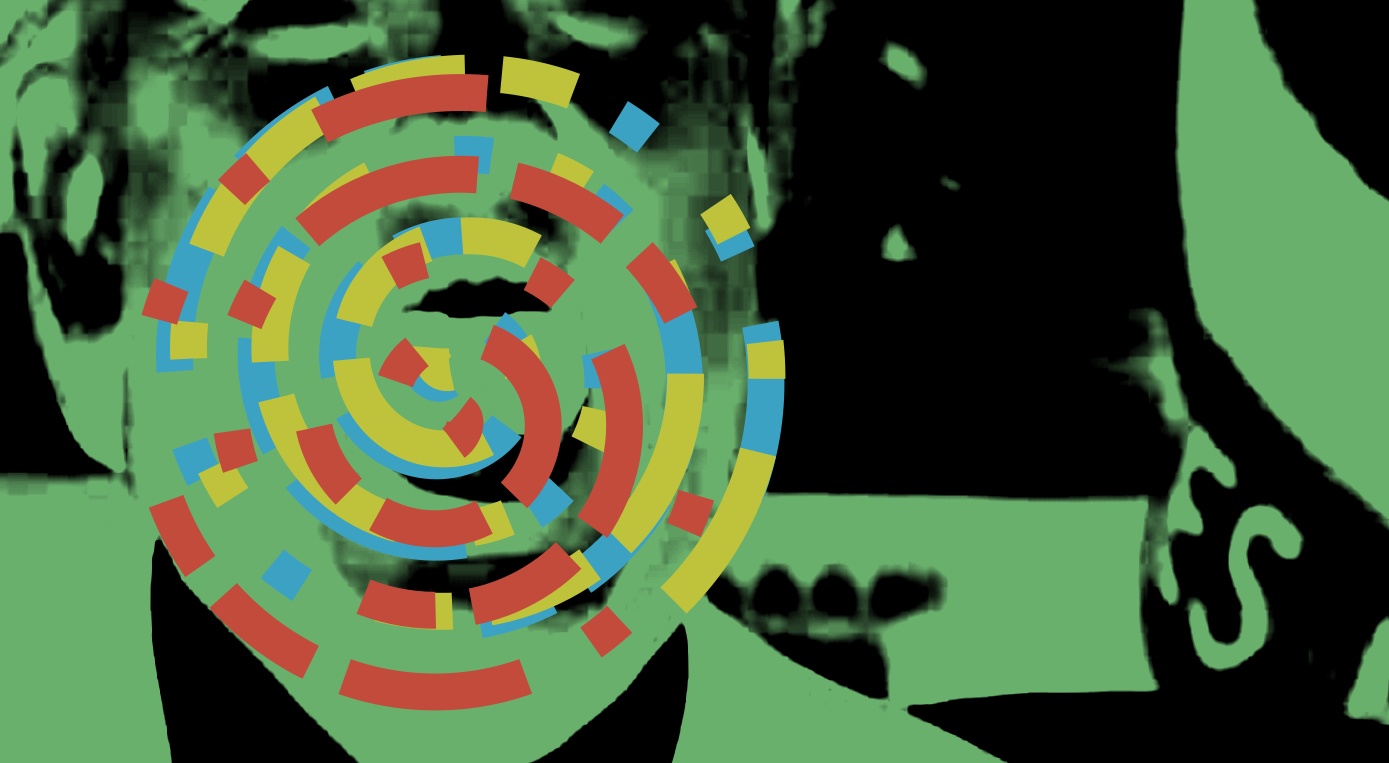
A distorted black-and-green closeup photo of Donald Trump with his mouth open as though he is yelling. Superimposed over his face (and centered around his mouth) are overlapping red, yellow, and blue spirals, each broken up into different sized segments.

Before anything else, I should point out that my research over the past decade or so has focused primarily on the language and narratives of far-right populist movements. That covers a lot of territory, but I generally have not looked closely at, for instance, the language of authoritarian states specifically. The reason is not because there is always a clear line between the two, but because there are only so many hours in the day, and sometimes you just have to set limits.

There clearly is a lot of overlap between the two, and the current Trump administration and its Make America Great Again (MAGA) movement make that abundantly clear. Trump’s persona going back at least to the 1980s has been that of a man who wants to do nothing more than project a cartoonish image of wealth and splendor. One of his superpowers is that he has been able to maintain that image at the same time that he has built up his current self-projection as an enemy of elites. Now he is both extremely wealthy and literally the president of the United States. The populist rhetoric continues, and the absurdity just accumulates.

The upshot is that, even when a populist movement takes state power, it doesn’t have to stop attacking purported “elites,” although it may have to find new people to fill that role in the eyes of the faithful. As I said, state language is not really my field of expertise, but I believe that looking at the emerging official verbiage of the US government in terms of reactionary populist language may be useful here, even if I do not have a wide range of references to state actors to draw on.

Continue reading

Is There A “Great Replacement” If You Can’t Read French?

No. “The Great Replacement” isn’t real in any language. Thank you for your attention to this matter!

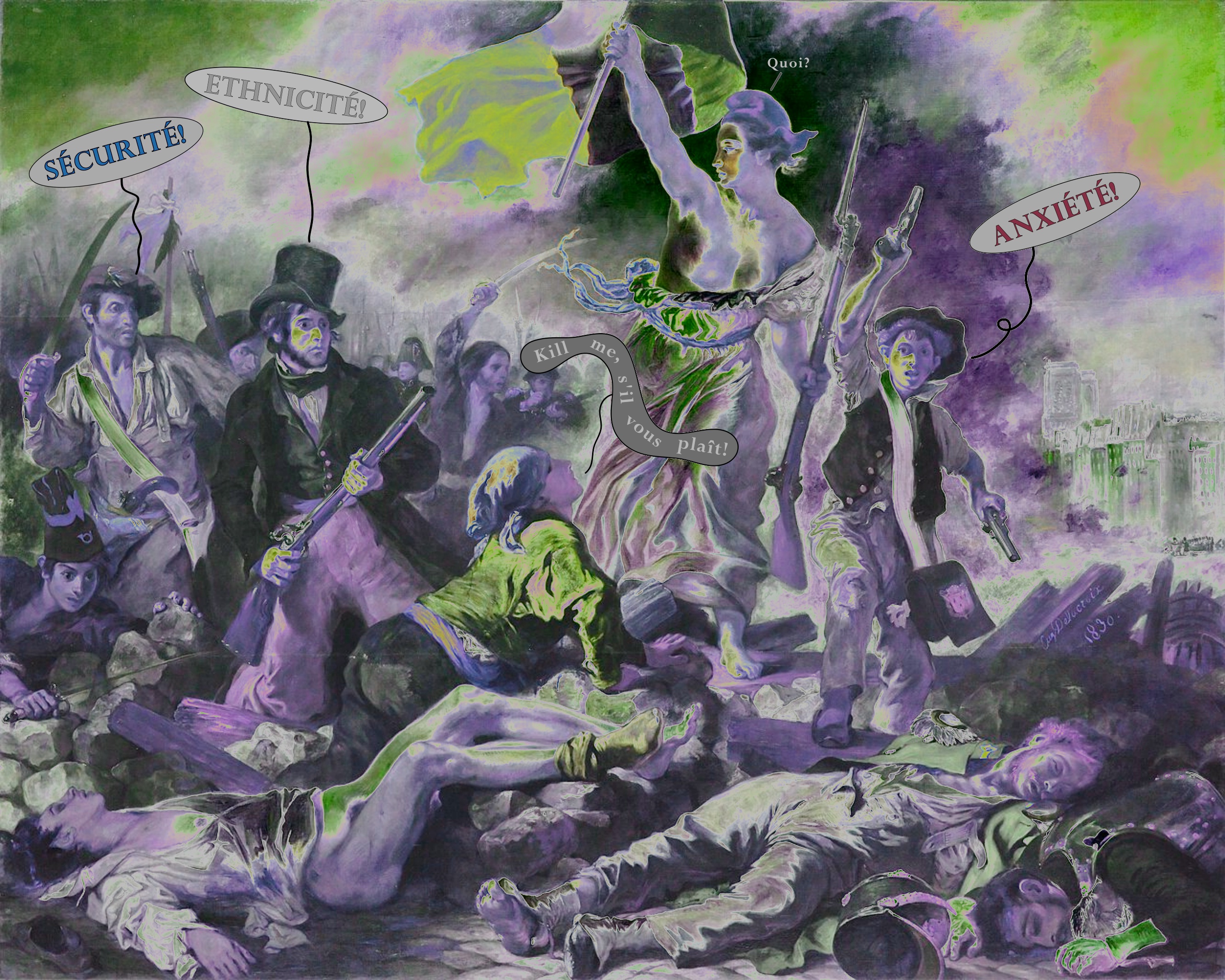
A dark, solarized version of Eugène Delacroix's painting "Liberty Leading the People." Three of the men in the foreground have speech bubbles shouting "Securité!" "Anxiété!" and "Ethnicité!" Marianne, in the middle carrying the French tricolor, asks "Quoi?" while another woman at her feet asks her to "Kill me, s'il vous plaît!"

Unfortunately, however, there are far too many people with very loud voices who keep telling us that it is actually happening, and they are having an impact on both official policy and real-world events in the US, Hungary, Britain, Australia, and elsewhere, so we have to talk about it. In particular we have to talk about why, as a concept, it has been at the heart of such aggressive, even deadly action.

The term was popularized after it was used as the title of a 2011 book that was written in French by French nationalist Renaud Camus; he self-published a second book with the same title the following year. No English translation of the 2011 book has never been published, and there is no widely distributed English translation of the 2012 book either (an abridged translation of the second book was posted on /pol/ at some point before or during 2023, however its circulation appears to be quite limited). So if the term and its explanation have been made available to English-language readers only on a rather restricted basis, why and how was it so readily and widely taken up on the international English-speaking right?

The following is part one of a three-part essay and the first in what will likely be an ongoing series of posts about the deep roots of “replacement ideology,” or anxiety about demographic loss, displacement, or substitution and the associated idea that aggressive measures are needed to rid the national community of outsiders as a matter of collective self-preservation. I’m calling it an ideology because its status among far-right actors goes well beyond a mere slogan or theory, instead forming a complete (if internally contradictory) worldview and a way for reactionary individuals to understand their own relationship with the world around them.

In particular, this post will look at the concept of “the Great Replacement” in terms of what is known as constitutive rhetoric. A classical definition of rhetoric itself would be something like: language that is intended to persuade or change someone else’s mind – to move a person from one camp to another. By contrast, constitutive rhetoric does not seek to change a person’s mind so much as to tell that person that they are already in a particular camp (or more precisely: that they are part of a particular community) and then to induce them to take corresponding action. It’s a useful theory and one that I think will help make the spread of a lot of far-right concepts easier to understand.

Continue reading

Subtlety, MAGA-Style: “The Snake”

One thing that even casual observers may recognize as a staple of Donald Trump’s rallies over the past decade is his recitation of the lyrics of the 1963 song “The Snake.” There’s a formula to it. He presents it as a poem as he theatrically pulls out a piece of paper to read it, often saying that he only does this because of all the requests he gets for it. He has read the text so many times that you might wonder why he still needs it written down. After building so much of the Trump 2.0 brand on the feeble-mindedness of his only slightly older predecessor, could he be losing his memory? It’s a distinct possibility. But also, theatrics are his strong suit, and it’s too late to teach him new tricks.

A closeup photo of Donald Trump's face, solarized and high contrast, making all the contours of his skin look a bit scaly. There is a colored filter making the whole image look green, and his eyes have been turned yellow with pupils that are vertical slits like those of a snake.

His “poem” was written and recorded by soul singer Oscar Brown (complete lyrics here), although Trump never acknowledges its author. It sold relatively well at the time and was then recorded by Al Wilson in 1968, which became the best-known version. The lyrics tell a story of a woman who finds a “half-frozen snake” on her way to work one morning. She takes the snake in, warms him by the fire, and gives him “some honey and some milk” until he has been revived. But being a snake in a parable, he bites the woman, and before she dies, she asks him how he could do such a thing. His reply:

“Oh shut up, silly woman,” said the reptile with a grin
“You knew damn well I was a snake before you took me in”

Each verse ends with the same refrain:

“Take me in, oh tender woman
Take me in, for heaven’s sake
Take me in oh tender woman,” sighed the [vicious] snake.

Brown didn’t include the word “vicious.” That’s just something Trump likes to add, likely because he can’t work out the rhythm otherwise.

The lyrics are not particularly complex, but in context, the story they tell says a number of things about Trump, his supporters, and the way that far-right narratives often function. So the following is going to be an attempt to break down why its content appeals to MAGA movement participants, how Trump’s presentation deviates from what Brown (or Wilson or any other singer who has ever recorded “The Snake”) likely ever intended, and how it fits into the cosmos of reactionary rhetoric more broadly. It’s about gender, it’s about race, it’s about history, and it’s even about empathy. That sounds like a lot to suck out of such a simple song, but its simplicity is what makes it a useful entry point into the broader issue of far-right narrative. So here goes…

Continue reading

“Ethnopluralism,” or the Reactionary Desire for Apartheid on a Global Scale

Anxiety about losing power combined with a desire to shore up (or reclaim) elite status has often led people on the reactionary right to want to keep their distance from their lessers due to a fear that those they have historically kept down might assert themselves and take power.

Starting in the nineteenth century, this manifested in a fear of racial “contamination,” which was codified with the development of modern “race science.” The first important text in that regard is Count Arthur Joseph de Gobineau’s Essai sur l’inégalité des races humaines (Essay on the Inequality of Human Races), published in two volumes between 1853-55. Gobineau’s Essai is a rather blunt (and not exactly scientifically rigorous) assertion of the overall superiority of “Aryan” blood and a warning against the dangers of mixing it with the blood of other “races.”

After Charles Darwin published his Origin of Species in 1859, his half-cousin Francis Galton became fascinated by the idea of applying Darwin’s theory of evolution not just to different species of animals but to different categories of humans as well. He developed an elaborate theory about “genius” and its tendency to run in families (his analysis happened to place his own upper-class family at the top of a global intelligence hierarchy), and in 1883 he coined the term “eugenics” to describe his concept of using artificial means to engineer a particular vision of human evolution. His schema clearly involved a racial component that included encouraging people to make breeding choices that would result in traits suitable for particular geographical settings.

In 1909, German biologist Jakob von Uexküll began using the term Umwelt (meaning surroundings or environment, literally “around-world”) to describe what he thought of as the holistic totality of a living organism, including the particular conditions in which it existed. Like Galton, he made the scientifically dubious choice to use biological and environmental science as a way of theorizing human difference. He concluded that the best thing would be for everyone to stay in their proper location and for each group to remain permanently isolated from one another. In the early 1930s (just as Hitler was rising to power), this led Uexküll to conclude that, for instance, Jews did not belong in the German Umwelt and should be expelled to live somewhere else. His ideas never really became official policy, however they did mesh quite neatly with Nazi “blood and soil” ideology.

The language of white supremacy and the associated fear of racial “contamination” have never gone away, but they do continually shift: “anti-miscegenation” laws have been invalidated in the US, yet it is possible to launch a successful presidential campaign by describing immigrants as “rapists,” which still invokes the same threat that brown-skinned men allegedly pose to the purity of white women; most French politicians would stop short of saying that Muslims don’t belong in France, yet the language of laïcité is invoked over and over to make it clear that expressions of Islamic culture should be hidden from public view or eliminated altogether; etc.

One of the more sophisticated innovations on the part of global segregationists has been the invention of the term “ethnopluralism” (or its French counterpart différentialisme). It’s an awkward bit of jargon that was concocted by members of the French and German New Right in the 1960s–70s as part of an ongoing effort to reframe old ideas for a new context. The following will be an examination of the term’s meaning, origins, and spread as well as its rhetorical value for a global movement of racial domination.

Continue reading

What We Mean When We Talk About Fascist Language

I’ve decided to attempt a regular series of blog posts focused on language and the far right because, on the one hand, I think it might be useful for other people and, on the other hand, giving myself a regular publication schedule will, I think, help me to work through my own thoughts. So here goes.

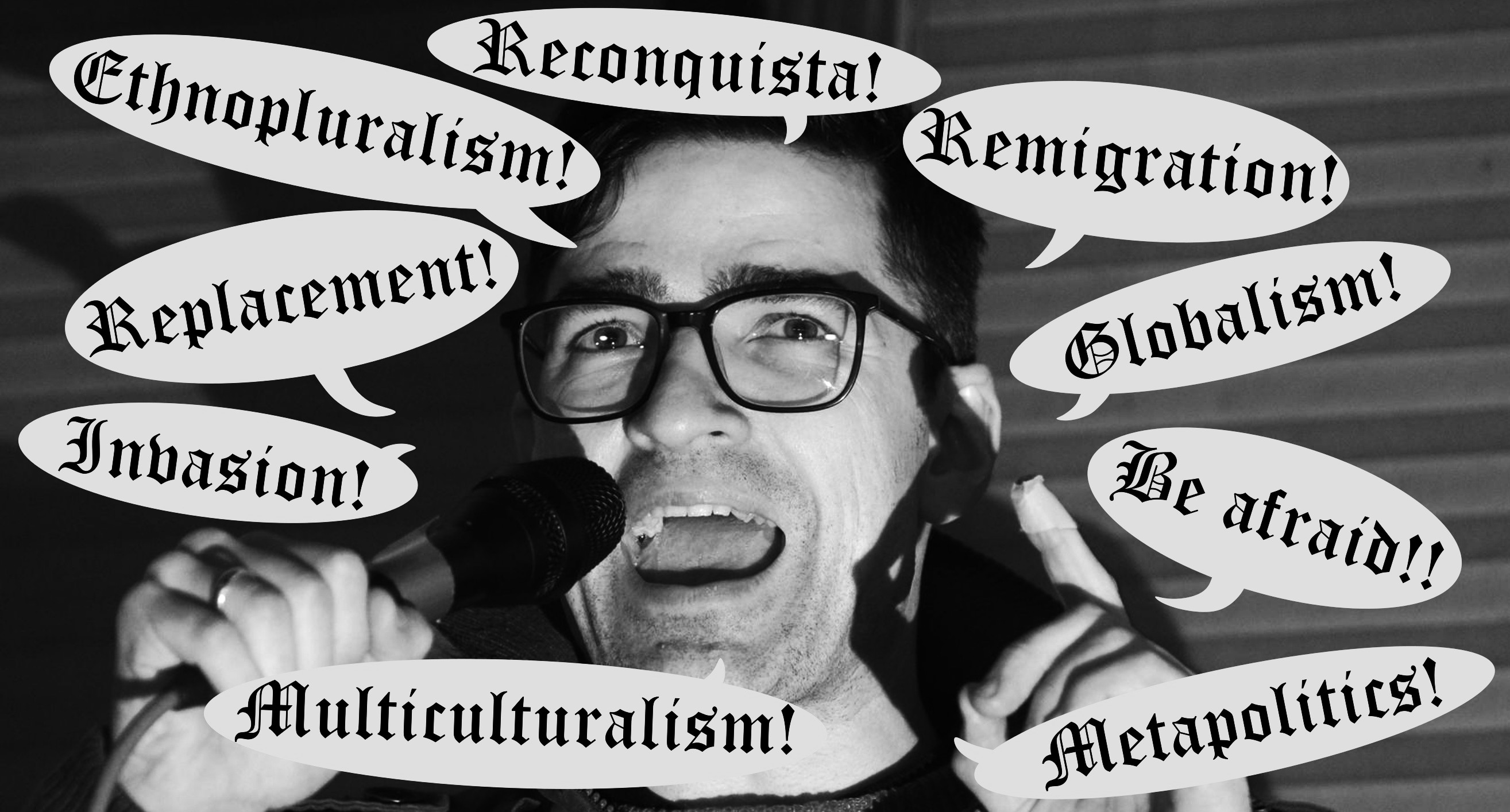
A creepy, shadowy black & white image of Martin Sellner holding a microphone with his mouth wide open. He is surrounded by speech bubbles containing the following words in Fraktur script: Reconquista! Remigration! Globalism! Be afraid!! Metapolitics! Multiculturalism! Invasion! Replacement! Ethnopluralism!
“Identitarian” leader Martin Sellner opining
(Adapted from an original photo by Sebastian Willnow / picture alliance / dpa)

On Being a Witness to Fascist Language and Its Consequences

For the first post here, it seems only right and proper to start by discussing the first chapter of LTI, Victor Klemperer’s landmark 1947 book on the Nazi party’s use of language. Klemperer, a German-Jewish philologist who survived the Holocaust in large part (by his own telling) thanks to the support of his “Aryan” Protestant wife, kept a diary throughout the Nazi era. Being a word guy, he naturally kept track of what he called the Lingua Tertii Imperii (Language of the Third Reich, or LTI for short), and the book is based on the portions of his diary that dealt specifically with Nazi language. (The rest of his diaries have been published in various forms over the years, and at least some parts have been translated into English. I haven’t read the other volumes, but I’m told they offer an invaluable glimpse into daily life under Nazi rule, and I encourage people to read them. Scroll to the bottom for details.)

Chapter 1 of LTI addresses the parameters of what he considers to be “the language of the Third Reich,” which amounts to a rather broad spectrum. He begins by pointing to the variety of acronyms the Nazis used, noting that it was partly in response to (and as a parody of) the proliferation of Nazi acronyms that he privately coined the term “LTI” in the first place. Nonetheless, humor is in short supply in his description of its content. He writes

The Third Reich speaks with a dreadful uniformity from all its manifestations and remnants: from the exorbitant pomposity of its opulent buildings and from their ruins, from the soldiers and SA and SS men that it affixed on every kind of poster as idealized types, from its Autobahns and mass graves. All of that is the language of the Third Reich, and of course all of that is discussed in these pages. (Klemperer, 20)

Shortly thereafter, he also mentions “the language of shop windows, posters, brown uniforms, flags, arms extended in Nazi salutes, and pruned Hitler mustaches” (21). Language is never limited exclusively to verbal speech or written text, and that is particularly true of language that is meant to persuade, maintain the ideological orientation of the already persuaded, or remind dissenters of their own subordinate status.

Continue reading