
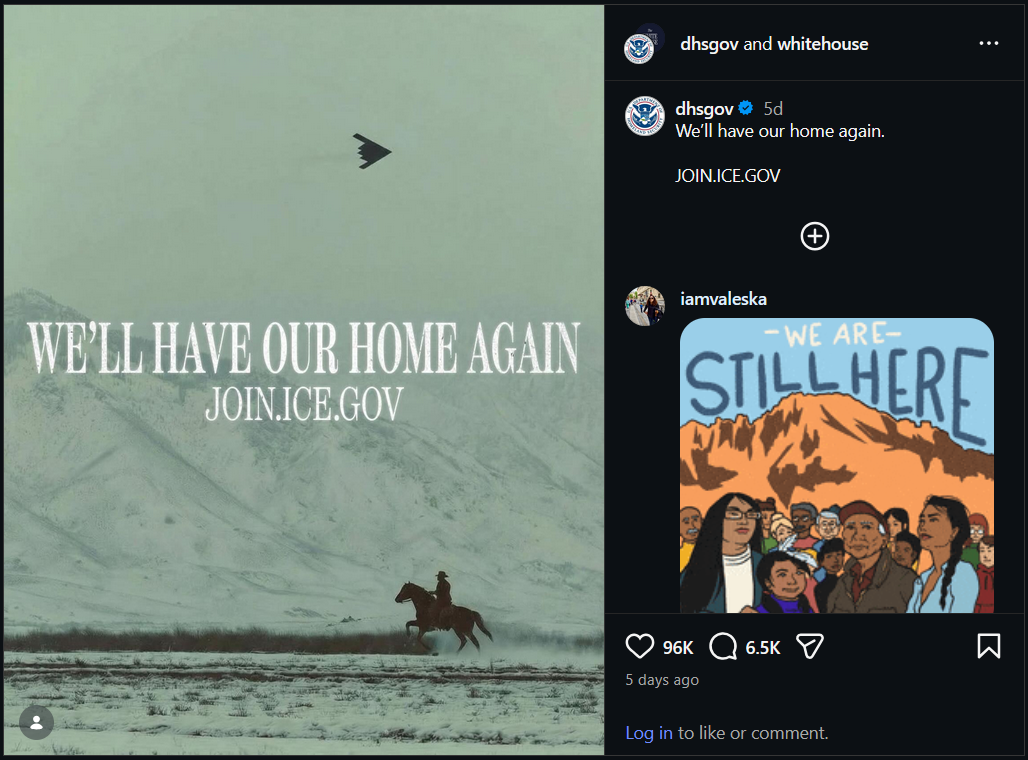
On January 9, 2026, the US Department of Homeland Security (DHS) published an image on Instagram and Twitter of a solitary cowboy riding a horse through a rocky desert. It is a classic scene from the American west that could have come straight out of a John Ford movie – at least most of the photo could have. But far above our lone hero, for reasons that are beyond the comprehension of mere humans, is a stealth bomber. And between the two is a caption that reads “WE’LL HAVE OUR HOME AGAIN” along with the web address for the Immigration and Customs Enforcement (ICE) recruitment page.
Published just two days after an ICE officer murdered Renee Good in her car in Minneapolis, it should be no surprise that this image was subject to a lot of pushback. That was partly due to the blunt racism implicit in the idea that the state security apparatus has to take back “our home” from immigrants and partly due to the erasure of indigenous people, both past and present.
But another reason is that the phrase “We’ll Have Our Home Again” is also the title and refrain of a song that has been popular among North American neo-nazis for several years now.
The implication is not subtle, and I don’t want it to be missed among the details presented below, so I’m just going to say this clearly right here at the start: in citing this song by name in a recruitment ad, DHS is speaking directly to actual neo-nazis and telling them “We want to hire you.”
Trump and his supporters have had an all-too-complicated relationship with self-identified nazis over the years. It has been evident since Trump first announced his candidacy in 2015 that he was always going to run on racial resentment, blustering machismo, and raw elitism, and the policies he enacted during his first administration were consistent with that agenda. Once in office, however, much of the alt-right that cheered his rise quickly abandoned him because, in their view, he didn’t go far enough. In particular, they pointed to the difficulty Trump had building even part of the wall that he promised along the US-Mexico border, and they cited immigration statistics showing a continued loss of white numerical dominance. But just as damning was Trump’s support for Israel and the presence of Jews in leadership positions in his administration. The prominent role played by Trump’s son-in-law Jared Kushner was a constant reference point, and the fact that Trump would “allow” his Aryan daughter to convert and to produce children with the eternal racial enemy was just blasphemous. (How they didn’t know about this before the election is beyond me.)
During his second administration, Trump has largely alienated neo-nazis due to his continued support for the Israeli state and his lip service to the idea of combating antisemitism, however he has also taken steps that seem explicitly designed to make the US an all-white nation in ways that go far beyond even the policies of his first administration (which were already extreme). This is most visible in his wildly aggressive crackdown on mostly non-white immigrants and their descendants (whether or not they are citizens) and his offer of refugee status to white South Africans while also moving to cut off asylum claims from most of the rest of the world. These are actual policies that make even his first-term comments about “shithole countries” and the supposed need for more immigration from Scandinavia pale in comparison.
Nonetheless, while all of these previous moves have won Trump some (often grudging) approval from many white nationalists, he and his cabinet members seem to almost reflexively want to maintain the thinnest possible veneer of plausible deniability – just enough so that the more passive racists can continue to support him because, hey, he doesn’t hate anyone, he just wants to fight crime or something.
Citing “We’ll Have Our Home Again” is different. This is a song that is all but unknown outside of neo-nazi circles, but it is very well known within them. It is about the most specifically targeted dog whistle I can imagine. This is a call not to the generic racists who would rather not have to ever hear languages other than English or smell foods that aren’t on the menu at Cracker Barrel but rather to people who already have an explicit idea in their minds of just what they think an all-white country would look like and a fairly clear idea of how to get there. It is a call to the kind of people who really do read The Turner Diaries as inspiration – even a kind of blueprint – for forging a white ethnostate or who regard The Camp of the Saints as an allegory for the consequences of failing to do so. They have been trying to figure out how to violently DIY their way into just such a country for decades, and now DHS has signaled that it wants to elevate them to gun-toting, badge-wielding agents of the state.
The difference between, say, banning immigration from a list of Muslim-majority countries and directly appealing to neo-nazi recruits (while also continually adding to the list of banned countries) may only be one of degree, but at least in terms of the Trump administration’s relationship with its base, it is the difference between keeping casual racists happy versus calling on people who are openly pro-genocide. Fascists often seek to prevail by taking one inch at a time and disarming their adversaries by painting them as alarmists or worse, and this ad represents another inch taken. It is entirely possible that it was solely the product of one or two covert groypers working in the DHS social media office, but that doesn’t actually change anything. The signal has been given, and there is no real chance that DHS is going to start weeding out nazi recruits any time soon.
Continue reading

 Total Propaganda