The Roots of “Replacement,” Part 2: Replacement as a Colonial Value

[Note: This essay quotes some extreme racist language, including genocidal rhetoric.]
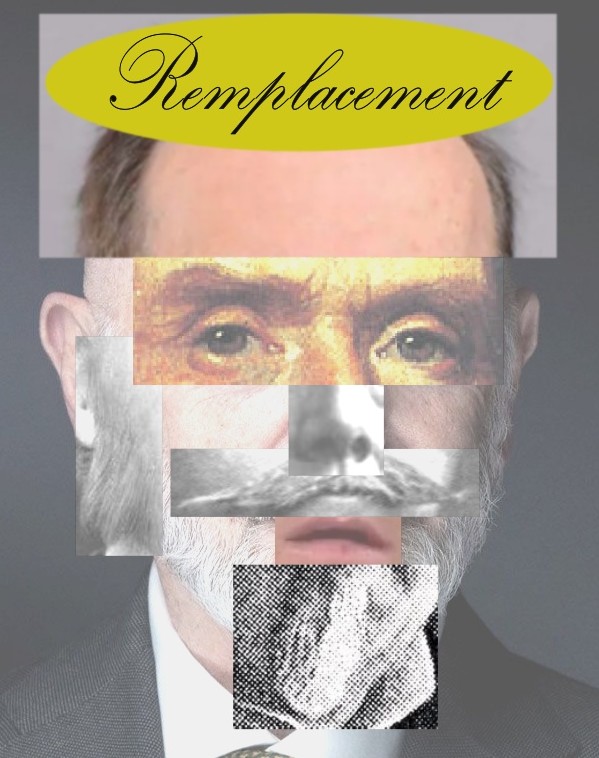
French nationalist Renaud Camus with the forehead of Alain de Benoist, the eyes of Thomas Jefferson, the sideburn of Francis Galton, the nose of Houston Stewart Chamberlain, the mustache of Madison Grant, the gaping mouth of Tucker Carlson, and the goatee of Arthur de Gobineau

Over the past decade we’ve heard seemingly endless variations on the “Great Replacement” trope from TV personalities, right-wing influencers, politicians, and howling neo-fascists on our streets. It has often been condemned as a conspiracy theory and a not-so-thinly veiled statement of anti-immigrant sentiment, but beyond that, most criticism takes the coinage of the term itself as its starting point, limiting its history to the past decade and a half. What is often left out is that the language of “replacement” has been able to spread so widely in part because replacement rhetoric has been embedded in Western thought for much longer than that.

For our purposes, we can roughly define replacement rhetoric as speech that is intended to provoke opposition to changes that allegedly threaten to alter existing demographic proportions and undermine the numerical advantage of a dominant group. In practical terms, this means opposition to immigration (and to immigrants themselves), regardless of whether or not any evidence exists showing actual harm done to the established population. Rhetoric of this kind can be traced back to at least the mid-nineteenth century and arguably well before that: if it is not necessarily a direct descendant of previously existing rhetoric in favor of “replacing” indigenous populations, then it is at least a close relative.

A previous post on this site raised the question of how the term “the Great Replacement” came to be used so widely within the English-speaking far right despite the fact that it is derived from French texts that have never been widely circulated (if at all) in English. It also addressed the way that French nationalist Renaud Camus, who coined the term, evocatively explained its meaning using what is known as constitutive rhetoric.

The next few posts will look at the long history of elite replacement rhetoric in Western Europe and the United States throughout the nineteenth and early twentieth centuries and how that rhetoric still echoes in the present day. In the meantime, however, the present essay will start by looking at the early part of that period – when Western political and intellectual leaders were so confident in their global power that they openly plotted and in some cases even executed the “replacement” of populations they regarded as their racial subordinates. If it is true that white people often harbor a fear that what whiteness has done to others may one day be done to them, then this background should help us understand a little bit better how and why fear of being “replaced” took hold.

Continue reading
Is There A “Great Replacement” If You Can’t Read French?

No. “The Great Replacement” isn’t real in any language. Thank you for your attention to this matter!

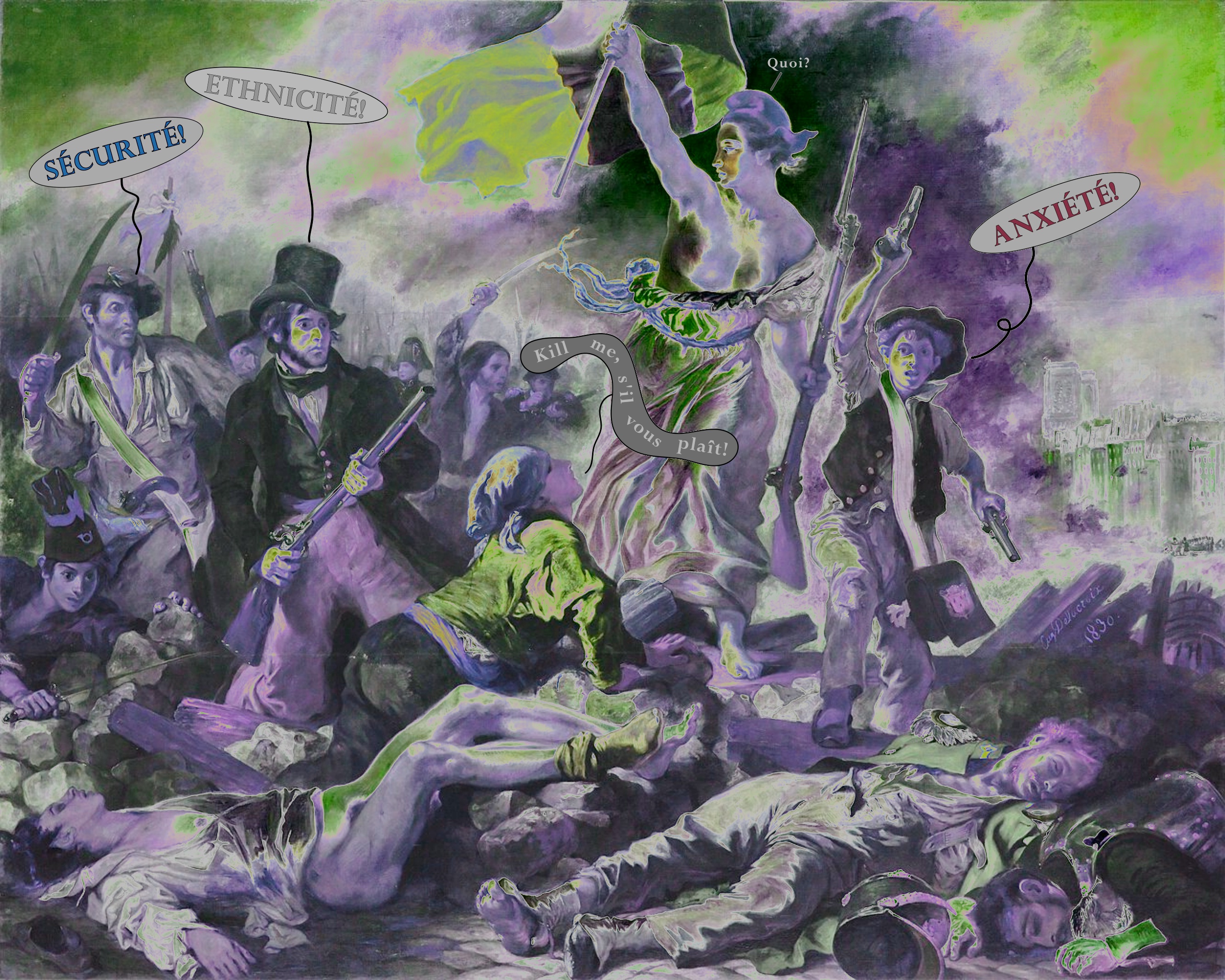
A dark, solarized version of Eugène Delacroix's painting "Liberty Leading the People." Three of the men in the foreground have speech bubbles shouting "Securité!" "Anxiété!" and "Ethnicité!" Marianne, in the middle carrying the French tricolor, asks "Quoi?" while another woman at her feet asks her to "Kill me, s'il vous plaît!"

Unfortunately, however, there are far too many people with very loud voices who keep telling us that it is actually happening, and they are having an impact on both official policy and real-world events in the US, Hungary, Britain, Australia, and elsewhere, so we have to talk about it. In particular we have to talk about why, as a concept, it has been at the heart of such aggressive, even deadly action.

The term was popularized after it was used as the title of a 2011 book that was written in French by French nationalist Renaud Camus; he self-published a second book with the same title the following year. No English translation of the 2011 book has never been published, and there is no widely distributed English translation of the 2012 book either (an abridged translation of the second book was posted on /pol/ at some point before or during 2023, however its circulation appears to be quite limited). So if the term and its explanation have been made available to English-language readers only on a rather restricted basis, why and how was it so readily and widely taken up on the international English-speaking right?

The following is part one of a three-part essay and the first in what will likely be an ongoing series of posts about the deep roots of “replacement ideology,” or anxiety about demographic loss, displacement, or substitution and the associated idea that aggressive measures are needed to rid the national community of outsiders as a matter of collective self-preservation. I’m calling it an ideology because its status among far-right actors goes well beyond a mere slogan or theory, instead forming a complete (if internally contradictory) worldview and a way for reactionary individuals to understand their own relationship with the world around them.

In particular, this post will look at the concept of “the Great Replacement” in terms of what is known as constitutive rhetoric. A classical definition of rhetoric itself would be something like: language that is intended to persuade or change someone else’s mind – to move a person from one camp to another. By contrast, constitutive rhetoric does not seek to change a person’s mind so much as to tell that person that they are already in a particular camp (or more precisely: that they are part of a particular community) and then to induce them to take corresponding action. It’s a useful theory and one that I think will help make the spread of a lot of far-right concepts easier to understand.

Continue reading